Showing posts with label Politics. Show all posts

7/21/18

A response to the celebrated Egyptian elite "activists'

A group of Egyptian activists and ordinary citizens who are never mentioned in English media coverage

For some reason Middle East Eye decided to interview only a handful of famous activists who are not only known to have very liberal positions, but also are very open about having supported and rallied people in Egypt and abroad for #June30. 

While they have all by a way or another paid a price from their personal freedoms due to the crackdown of the Egyptian military dictatorship on all opponents, they all clearly insist on stating that they "don't regret supporting #June30", a movement recognized as undemocratic, irrational, and catastrophic by all those who care or don't care about the prosperity of Egypt.   

It is shocking and disappointing to see how Middle East Eye is shifting more and more towards giving a platform only to liberal and secular celebrity voices in Egypt, a trend that has been apparent in the majority of western media outlets since protests erupted in Egypt in 2011.

If Middle East Eye is seriously concerned with the Egyptian turmoil they need to do a better job than this. You can hire an Arabic-English translator or try to find more people to interview other than the 10 upper-middle-class Egyptians who supported the coup whom everyone in the world interviews since 2011.

We are writing this blog however because we were delighted to see a wonderfully written response from a commentator on the silly article. The comment breaks down the issue of Egyptian liberal elites contributing to the crisis in Egypt. To our surprise, the comment was by Jim Toth, an anthropologist who studies Egypt, the Arab world, and the wider Islamic community. He has taught at the American University of Cairo and at Northeastern University, and since 2011, has worked at New York University in Abu Dhabi. He is the author of Rural Labor Movements in Egypt and Their Impact in the State, 1961-1992. 

Here is a link to the Middle East Eye article:


http://www.middleeasteye.net/in-depth/A-revolution-betrayed-living-in-Egypt-s-worst-era-1003870706
 
Here is Jim Toth's brilliant response:

Abdel Fatah and her friends are hypocrites. Democracy is when all the people voice their choice and opinion. She and her friends may have their own opinion – support Sisi and oppose Morsi – and so let them vote their choice along with all the millions of other voters in Egypt by holding honest elections. 

But to support an anti-democrat such as Sisi and to support the anti-democratic forces that removed Morsi without due process of an election – this is hypocritical. Don’t say Abdel Fatah was a “co-founder” of April 6. She and her friends are still hypocrites because in the last election
prior to July 3, Morsi had won, and they should, if they are true democrats, respect the people’s decision. 


It is not up to them and their elitist friends (the National Salvation Front) to use their social position, their access to the media, and their westernized demeanor to then remove a democratically-elected president, or support his illegal removal, whether or not he made serious mistakes (mistakes that were amplified and exaggerated by an anti-Brotherhood media). 

Nobel prize? Perhaps she ought to stand in line behind Trump. Both are so preposterously unqualified for a Nobel prize that to consider them seriously degrades the value of the prize itself.

For good reason or bad, the majority of ordinary Egyptians had voted in Morsi, and thus, Abdel
Fatah, along with her elitist friends, along with Sisi and the military, have no right in a democracy to overturn the election, unless they are willing to admit it is anti-democratic act and, therefore, the first step on the road to an authoritarian regime. To then pat themselves on the back and say “what good liberals we are” is the height of hypocrisy.


Is this a conflict between “east Cairo” (old Islamic Cairo) (along with Giza) against European Cairo (the nationalists) and the “wings” of New Cairo and October 6 (the neo-liberals)? Abdel Fatah and her crowd are so willing to dismiss the values and principles of the majority of her country-men and -women in those areas who wanted, and voted for, an uncorrupted (naïve?) candidate as president, one that did not have all the un-Egyptian trappings of ibn al-zayyat. In the last presidential elections, many more Egyptians supported a Muslim Brotherhood government than they supported a secular, westernized elitist government. 

She and her friends ought to recognize that, show some humility, some respect, and in democratic fashion, work within the system rather than support and commit extra-legal, unconstitutional acts.

For all her deeds, and those of her friends, they got Sisi, a 100-fold worse than Morsi. Had they been patient, respectful, and lawful, or had insisted on respect, legitimacy, and real democracy, they would not be stuck with Egypt’s worst dictator.

Perhaps they got what they deserved, but, of course, they are not going to be the ones who really hurt for it. But it is the Egyptian people, those unable to make it through the dismal economy and those jailed for belonging to the Brotherhood, who do not deserve this calamity. 

This crime lies squarely on the shoulders of the secular liberals who ought to have known better, but made a pact with the devil in order to assure themselves that their beliefs and way of life are better than those of the majority of Egyptian.

3/26/18

Egyptian Presidential Elections: 2012 and now

Today is the beginning of the farce elections where General Abdul Fattah Al Sisi is the only candidate running. You don't hear much anywhere in the world that this is taking place because it's a shameful joke that nobody is going to take seriously. 

I remember how things were completely different 6 years ago during the elections in 2012. Although I decided not to vote to any of the candidates, I can't deny that the atmosphere and the accomplishments we made were a source of pride and hope for us Egyptians and everyone else who was following us around the world.

Egypt experienced 1 genuine historical round of elections in 2012 after the blessed Egyptian revolution of January 25th, 2011. While it wasn't 'perfect', it was the closest experience to a democratic process Egypt could have dreamed of at that time.

After the revolution, Egypt was trying to recover long decades of military dictatorship, oppression, lack of political space, and tons of social and political illnesses.

The 2012 round came as a result of the efforts and sacrifices of the Egyptian revolutionary when their expectations and dreams were the strongest voice in the whole country.

The Supreme Council of the Armed Forces (SCAF) didn't want ANY elections held but the people at that time were pushing hard and made it possible.

Egypt had dozens of presidential candidates, Egyptians were discussing politics openly everywhere, electoral campaigns were active all over the country, freedom, excitement, and aspirations were all in the air. There was no way you could miss all of this or take it lightly. This was literally the very first time Egyptians were given the choice of choosing their ruler in a very very long time.

The overthrow of Muhammad Morsi, the first democratically elected president of Egypt who is now suffering medical negligence in prison, destroyed all of this. That's why June 30th, 2013 was a cheap military coup and if you think otherwise and claim to be a 'revolutionary' you are either deluded or fooling yourself. We will continue to speak up. 

2/28/18

Statement on recent BBC report Feb 2018


The BBC made a story recently on politically motivated enforced disappearances in Egypt after the military coup in 2013. The report featured a few cases one of them was a middle aged Egyptian woman who spoke on her daughter named Zubayda who was kidnapped and disappeared by the Egyptian state for over a year. Her testimony brought so much attention and created an uproar in the Egyptian social media sphere to the degree that the Egyptian state had to do something.
This isn't the first time local and international human rights organizations or international media spoke of the phenomenon. When the Italian PhD student Giulio Regeni was disappeared and then killed in Cairo the whole world spoke of the incident for a long time. Local and international human rights organizations have documented and spoke of 1,000s of enforced disappearance cases for the past 4 years.
However, this latest report seemed to disturb the Egyptian state so much to the degree that they eventually forced the young woman Zubaida who was disappeared for a year to come on Egyptian TV and deny that she was arrested and disappeared as the BBC report showed. It was a pathetic set up and it was clear that Zubayda had to do this under so much pressure. Her mother who appeared on the BBC was detained today, Feb 28th, 2018.
The Egyptian general prosecutor ordered lawyers and prosecutors to "Watch and report news and reports made by forces of evil". Pro-Sisi's social media accounts are roaming the internet denying that there is any torture, imprisonment, or enforced disappearances in Egypt.
While there is some spotlight on the situation in Egypt and while the issue is hot, we wanted to remind the international community and those who are confused because they can't get reliable information on what is going in Egypt that there are atrocities being committed in Egypt while the whole world is ignoring us.


We wanted to remind all of you that there was a military coup in July 2013 and that as a result of this tragedy thousands of Egyptians have paid a very high price for standing against injustice. We wanted to remind all of you that there are tens of thousands of unjustly imprisoned men, women, boys, girls, and elders whose only crime was speaking up. Ignoring what is going on in Egypt while you can say something helps the Egyptian state continue to get away with all of this.
We would like to salute all of the local Egyptian human rights organizations and human rights defenders who are working under so much pressure and risking their lives and future by continuing to do this work with very little support and recognition.
We would also like to thank the BBC team and those in HRW and other international organizations for utilizing their privileges and speaking about what is going on in Egypt from time to time.
Please check out our archives on the blog here as well as the following outlets for more related information and detailed reports on enforced disappearances in Egypt after the military coup:

The Egyptian Coordination for Rights and Freedoms

Verità per Giulio Regeni

7/29/17

Egypt's Ultras: A documentary

There has been very little that was written or documented in English and western narratives on the Egyptian Ultras, a very significant force in the Egyptian revolutionary movement and the Egyptian political scene.

This recent documentary production gives you a good overview on the Ultras and their role in the Egyptian revolution. For more information, check out our other blogs under the hashtags: Ultras, Port Said.


1/18/17

2017: 1500 Egyptians put on 'terrorist list' in Egypt!

Why would a super star footballer with an international reputation become on a terrorist list?
 Welcome to Egypt!


Mohamamd Abu Treka is one of the Egyptians who're recently put on a terrorist list.

January 17th, 2017:

In another attack on civil rights and liberties in Egypt, 1500 Egyptians were put on a terrorist list, most of them without any prior investigations and solely based on political foundation.

Among the names are Mohammad Morsi, the first civilian democratically elected president of Egypt as well as Mohamamd Abu Treka, one of the most popular Egyptian and Arab footballer and an icon for Al Ahly football team. 

The list has over 100 women, political prisoners, hundreds of youth, journalists, and Egyptians from all walks of life. There are also names of persons who are already dead. 

Some of these individuals have already been imprisoned for several years since the military coup ( over political charges), while the others who're outside will now face a serious threat of their rights being violated, assets being frozen, and passports taken away from them as well as several other restrictions on their travel, movement, and business in Egypt. 

Some of the individuals on the new terrorist list:

Samhy Mostafa is a journalist who's been in prison for 3 years and is serving a life sentence.
 Abu Bakr Mashali, a young Egyptian enginner who left Egypt after the military coup
 Hesham Gaffar, a leftist journalist and academic who's been in prison over political basis.
Sondos Asem, an Egyptian academic in Britain is one of the women who are put on the terrorist list recently and has received a death sentence. You can read her story here:


Who is a terrorist in Egypt since 2013?

The Egyptian state's definition of who is a terrorist was really stretched since the July 3rd military coup in 2013. Since then it includes anybody who opposes or criticizes the Egyptian state/government. 

It's important for the western policy makers as well as any non-Egyptian reader and follower of the situation in Egypt to understand the motivations behind these decisions made by the Egyptian state. 

5/30/16

Egypt fear of the beard: A missing perspective

Egyptian men grew beards all the time whether for religious reasons or as a habit, what went wrong in the past few years?
How do people view bearded men when they are Muslim? What happens when a society becomes very hostile to men with facial hair? Can you be a hipster with a hipster beard and pass as a hipster, not as a Muslim Brotherhood, and survive in today's Egypt?

What's taking place in Egypt can give you an idea about a dark scenario, where media and authority campaigning effort lead to stereotyping and vilifying a very diverse group of people. For more background check out this other piece we have written: 

Egypt fear of the beard:

This is an important perspective on the struggle of bearded men in Egypt who have fallen victims to an extremely harsh Islamphobic campaign after secular army general Abdul Fattah El Sisi took over the country. This feature piece discusses the different experiences of Egyptian young men from various perspectives, some of them have beards for religious reasons, some are affiliated with political Islamic movements, and others are doing it simply for the style, just like how any man anywhere in the world grows a beard.
At the end, they all face a similar degree of harassment and discrimination for how they look like.

From Middle East Eye, by: Maged Abul Dahab

The campaign against Islamic political movements has extended to appearance, and the beard is one of the main targets. 

Since Egyptian President Abdel Fattah al-Sisi rose to power, officially one year ago but in practice since the armed forces' declaration of 3 July, it was clear that his policy towards Islamic political movements was different from former presidents Hosni Mubarak or Anwar Sadat.
Sisi's policy is closer to that of Gamal Abdel Nasser - total and complete obliteration of Islamic movements, with a particular focus on the Muslim Brotherhood. One of the main tools to execute this policy was the use of the media - government-backed media specifically - to terrorise the Islamic political movements which seized the political initiative after the 25 January revolution.

The campaign against Islamic political movements was expanded to include a generalised crackdown on Islamic practices and outward Islamic appearance. And nothing symbolised the idea of the Islamic opposition and fear of "terrorism" more than the beard. The media emphasised the idea that bearded men were terrorists, or at least Muslim Brotherhood members.
Many lives were affected by this idea and subsequent reprisals that were taken against men who wore beards.

The student
Abdullah Farouk Kenibar, An Egyptian student, who was attacked while travelling from kafer El Sheikh to Cairo, because of his beard and Islamic appearance (MEE/Belal Darder)

Abdullah Farouk Kenibar is a 22-year-old student of medicine at the University of al-Azhar in Cairo. Kenibar is from Kafr al-Shiekh governorate, but he travels to Cairo every year to study. He comes from a religious family that considers the beard as a Sunnah (religiously prescribed practice). His home in Kafr al-Shiekh is near the house of the famous Islamic preacher Abu Ishak al-Houiny, who Kenibar holds in extremely high regard.

“In my first year of high school, I used to pray al-Fajr [the morning prayer] regularly at the mosque, and every time I met Sheikh Ishak, he would tell me to grow my beard to be similar to the Prophet Mohammed,” Kenibar explained. He started to grow his beard during his third and fourth years of high school.
It was 2011 when Kenibar was enrolled in the Faculty of Medicine at al-Azhar University. Everything was going well for him. Most of the students around him were bearded, and he had no problems interacting with the people of the city. He enjoyed being treated in high esteem on and off the university campus.

But things changed three months after Morsi became president. The aggressive tone of the media escalated against Islamists with each passing day. Kenibar and his friends began to feel the growth in animosity from those around them.
“I was in the bus going to the university. An old woman carrying a heavy parcel climbed into the bus. I got up from my seat to help her, and she immediately freaked out," Kenibar told MEE.

"She started calling me bad names, saying that I was Ikhwan [a member of the Muslim Brotherhood] and that we were the reason for the sabotage of the country.”
"That was the first time I realised how bad the situation was. It was also the first time I felt that my beard was a burden on my shoulders. If I wasn’t bearded, her reaction would have been totally different.”

Six months after this incident, Morsi was removed from power, and the Muslim Brotherhood alongside other political Islamic movements called for their adherents to take part in a sit-in demonstration in two main squares. During this sit-in - which lasted for about 40 days - media attacks on Islamists reached unprecedented levels.

At this time, Kenibar was at his family home in Kafr al-Sheikh. He would have stayed there all summer, but he needed to travel back to Cairo to complete some tasks at the university. “I’d heard that bearded men were targeted along the way from Kafr al-Sheikh to Cairo, but I felt that those who told me about this were exaggerating. Though I had learned that bearded men were treated differently, I didn’t think for one minute that I would really be targeted just because I wore a beard.”

Along the way to Cairo, Kenibar’s car was stopped by a group of men. Kenibar was attacked violently under the assumption that he was “Ikhwan”, and afterwards he was taken by the gang of men to a police checkpoint, again under the assumption that he was a member of the Brotherhood heading to Cairo to participate in the sit-in. Kenibar was detained briefly for this, and would have stayed in jail if it wasn’t for the interference of his uncle, a judge, who managed to get him out after three days of detention.

When Kenibar was released, the first thing he did was shave his beard. “I hated to shave it, but I was not going to risk that danger again. I was fortunate enough to have an uncle who was a judge, but what about the hundreds and thousands who have no important relatives and were subject to the same treatment?”

The photographer
Ahmed Fouad Hendawy is a 24-year-old photojournalist for Etfarag, an Egyptian news website. He has been working as a photojournalist for five years now, and has worn a beard since he was 18 years old. “I just like the way I look with a beard. I respect those who grow their beard for religious reasons, and I wish I could say that I grew my beard so God would be pleased with me, but it is simple in my case - I just like my appearance as a bearded man,” Hendawy explained.

Ahmed Fouad Hendawy, An Egyptian photojournalist, who was suspected and detained because of his looks (MEE/Belal Darder)
Hendaway’s job requires him to travel all around Egypt. He spends most of his days on the street. Wearing a beard never posed a problem for him. To the contrary, he used to get positive comments about his beard and his hair, which he was growing long as well.

But then Hendaway started to face difficulties doing his job. "When Morsi became president, so much negative light was shed on the Brotherhood and the Islamists. Our society is easily influenced and led, and it started to stigmatise all bearded men as Islamists and members of the Brotherhood,” he explained.

Some people even refused to be photographed by Hendaway, simply because he was a bearded man. “It was certainly a load on me. Many times I wasn’t able to do the tasks I was appointed to do. My boss kept asking me to shave my beard, and I kept refusing. I exerted double effort to get my tasks done without shaving my beard.”
Ahmed Fouad Hendawy, An Egyptian photojournalist, who was suspected and detained because of his looks (MEE/Belal Darder)

The breaking point was on the night of 7 July 2013. Hendaway was covering clashes between Morsi supporters and Sisi supporters in downtown Cairo, near Ramses Square. According to Hendaway, after about an hour, police forces intervened in favour of the Sisi supporters. Hendaway was able to capture images of police attacks on Morsi supporters. On his way to the office of the website, he was stopped at a checkpoint.

“People were passing by the checkpoint without getting stopped at all, but when I was seen, I was immediately stopped. It was clear that it was because of my long beard. Five minutes later I was ransacked, and of course the data on my camera was discovered, and I was beaten mercilessly, though I kept repeating that I am a journalist, and that I was just doing my job.”
Hendaway was led to a police station where he was detained for about a month, till the efforts of his website were fruitful, and he was released. He is now working extensively on documenting violations police forces carry out against journalists. He has also shaved his beard.

The Salafist
Ayman Osama, An Egyptian technician, who was forced to leave his work due to his long beard and opposed political views (MEE/Belal Darder)

Ayman Osama is 26 years old. He currently works as a technical consultant for a multinational corporation in Cairo. Formerly a student in the faculty of computer science at the University of Ain Shams, Osama used to be a member of a Salafi group. Before he joined the group he was a typical student, who spent his time hanging out with girls and joking around with his friends. After joining the Salafi group, he became more conservative, grew his beard, and became a regular attendant at the mosque on campus. This was noticed by Egypt's National Security apparatus.

“That was before the revolution of 25 January, so the National Security was interfering in the daily lives of the students,” Osama explained. “After about a month of growing my beard, I was summoned to the National Security office, where I was questioned about those with whom I spent my time, and why exactly I was growing my beard. They threatened to report me to the police.”

Then the revolution came. National Security was expelled from the university and Osama got a job in an Egyptian company right after graduation. That was before the election of Mohamed Morsi. “It was a good job, and I did well there, and I kept working there for about a year and a half, but after Morsi was ousted, and the whole Rabaa thing, I started to notice that my colleagues were talking about me behind my back. The way they interacted with me was gradually changing. Then one day my manager called me to his office and told me that I was going to have to shave my beard. They also said that it was preferable if I left the company because they didn’t want any affiliation with those who are like me.”

Osama was shocked by the rudeness of his manager. “I’ve had heated discussions with my colleagues about politics, I knew that most of them were Sisi supporters, but I never thought that I would be treated like that, only for having different ideas, opinions and appearance,” said Osama.
“I believe that what happened to me at the company is far more dangerous than what happened to me at the university. In the old days, the regime was targeting Islamists and bearded men, and it was understandable, as the regime was afraid of any kind of organised, committed opposition groups. But what happened at my work is that they managed to create dissidence and hate between different segments of society, which is, in my opinion, far more dangerous.”

Osama got a different job, one that allowed him to grow his beard. But he still shaved it, and says he will remain without a beard until the situation in Egypt gets better.

The Brotherhood activist
Ibrahim Abdo Ibrahim (R), a leading member of the Brotherhood at a protest held by the Brotherhood, a week or two after the raid on Rabaa Al Adawia sit -in, Ibrahim is now a fugitive, as he was sentenced three years in absentia (MEE/Belal Darder)

Ibrahim Abdo Ibrahim is 38 years old and a leading member of the Muslim Brotherhood. Abdo experienced detention during Mubarak's rule. “I was detained two times during the days of Mubarak," Ibrahim told MEE.
"Both times were just before the elections of the parliament. The first time was in 2005, when was detained for about two weeks. The other time was in 2010 for three days.”

After the events of 3 July 2013, Abdo and all members of the Brotherhood were called to go and participate in the sit-in at Rabaa Square. The calls changed after the raid on the square by police forces. The orders now were for everyone to participate in the processions held by the Brotherhood.

In October 2013, security forces raided Abdo’s home. This was expected to happen, because it was known that he was a member of the Brotherhood in his neighbourhood. Fortunately, Abdo was out the night the police raided his house. Since then, he has been a fugitive.

His wife took their two children and is staying with her parents. Abdo changes his location every two or three weeks, especially after he was sentenced in absentia for three years in prison for his affiliation with the Brotherhood.

“I am wanted right now, I haven't seen my family in about a year. I have to take many precautions so that I won’t be caught. But the most important one is to shave my beard. The police only suspect bearded men," he said. "Shaving my beard has gotten me out of many difficult situations.”

3/9/16

International Women Day: Egyptian women under military rule

International Women Day: Egyptian women under military rule in 2016
Prepared by: The Unheard Egypt team

Egyptian women: The female political prisoners and victims of the military:


Egyptian women and girls have been at the forefront of the movement in Egypt
On International Women Day 56 Egyptian women and girl are still in prisons for crimes they haven't committed. The U.S government and the EU governments continue to remain silent about all these violations. In facts, the numbers and realities show that they support and collaborate with this regime in its oppression against women. 

For the most part, there's been very little on the politically motivated violations of human rights against females in Egypt especially after the military coup. Only a few cases received some attention but for the most part there has been a continuous neglect for the reality of this crisis from international organizations and international media. 

From Twitter: Look at the hashtags: #IWD #IWD2016 #Egypt


Heba Qashta, the first female to receive a military sentence in a military trial who's been in prison since 2014 is an example for young Egyptian women who're arrested after the military coup, and yet don't receive as much media attention or humanitarian support, mostly because of their demographics. Being low income, from outside of the center of attention (Cairo), and not looking very western are among the reasons the bias takes place. 
Heba's family and friends have been trying to raise awareness about her case on their own, where they are in the Nile Delta, and it's a very admirable effort. ‪
Heba is born in 1994 and she was involved in her own campus in a governorate outside of Cairo, these are places the western media and international human rights organizations have continuously avoided and ignored. 

For more information about Egyptian women in prison you can check out these pages:

Save Egyptian women and children!!

Egypt Queens: Imprisoned 

Bent El Thawra (The daughter of the revolution) 

The Unheard Egypt


Egyptian women who're facing military trials
*Egyptian women: The family of the political prisoner:

"My soul is imprisoned with you!" is the slogan of the Egyptian woman who's a mother, a wife, a daughter, or a sister of a political prisoner in Egypt. The families of political prisoners are going through sever hardships and are getting their share of unjust inhumane treatment by the security forces, in addition to the emotional, psychological, and financial burdens they have to go through. 


Wives and family members of political prisoners camp over night in order to be able to see their loved ones the next day!
More details on Al Aqrab prison, and the hunger strike that's ongoing there:


An Egyptian woman protests sentencing her journalist fiance for life right before their wedding, in her never worn before wedding dress:


On March 8th, 2016 a group of Egyptian women protested in several parts of the country and made a strong statement against the imprisonment and forced disappearance of their family members and friends, who are also women and girls.
These events don't get any media coverage outside of Egypt because of the demographics of the women who are participating and organizing. Unfortunately, they are not prominent secular activists from Cairo. Many of them traveled for hours to participate, many of them are regular people.
Protesting is a very courageous act in Egypt right now and has a very high price, especially for women and girls.


Please help share this, and be their voice!

7/3/13

Important: Recommendations on #June30, 2013 in Egypt

Some of this was written In July 2013 before Sisi officially took over and some is right after. This perspective was very hard to find in English:

They're saying all the Anti Morsi folks are "revolutionary heroes" because opposition is always celebrated in the west even if it was opportunistic or reactionary. They're always right even if they're members of the old regime, pro-military, pro-Mubarak etc.

On the other hand, all Pro-Morsi folks are considered evil, ignorant, stupid, extremist and anti-revolution by default even if they're your family members.

This is the trendy logic nowadays everywhere, this is what the media and the activists/opposition sympathetic media is telling me to think constantly, and this is what most of the press has been suggesting but I'm not buying this, and I won't. 


*******************************************
Taken from a video after Sisi took over and overthrew Morsi:

"What do you think is the definition of democracy that we should stick with? If it's not decided by voting and polls and ballot boxes, what do you think is the way we can handle this?

Why wouldn't people who voted for Morsi be called pro-democracy activists just like we were called pro-democracy activists at the beginning of the revolution? ... What do you think is going to be the reaction of all these people who feel that their voices have not been respected? ... What do you think is left for them to resort to? ... What do you think is going to be the future of Egypt under military rule that we never got rid of? .

How about all the other people who live in other parts of the country besides Cairo's downtown... who are not as politically sophisticated as you might think we are, but don't want to see the military in power, and think that we can't be as politically active as you are because we have families and we have kids to feed and we feel that the only way to make things change here in this country would be through voting and electing a president to begin with. How do we explain things to these people?

With all the developments that are going to continue to happen, the instability and the violence, what do you think life will be like for these people? ...

Seeing two years of our lives wasted entirely and realizing that our lives might be at risk and that our future is uncertain"

On the Military Industrial Complex, SCAF, and revolutionary cheering for the junta:
  
The military never left any time actually in the last 60 something years, including last year. They're just coming to the face of the military dictatorship again, as you wished, dear "revolutionaries".

1- What you must know about the Egyptian military industrial
complex.

http://inalllanguages.blogspot.com/2013/01/what-you-must-know-about-egyptian.html

2- When a revolution calls for military rule.

http://inalllanguages.blogspot.com/2013/02/when-revolution-calls-for-military-rule.html

3- "If you're gonna try to compare civilian - even MB - government to brutality of #SCAF's rule, you're either blinded by hate or forgetful." 

"I’ve learned a basic and terrifying truth today: That many would rather see a military junta rule with impunity and autocracy than see a democratic administration govern with fecklessness and error. That many people who call themselves revolutionaries and advocates of democracy simply hate Islamism more than they love freedom. That people are fully prepared to welcome the army back to political life, with a cheer, two fingers up to those killed since 2011, and a good riddance to Egypt’s first experiment with democracy. Fuck that for a revolution."

Patrick Galey, July 1st 2013. The day the revolution died.

4- Videos and images:

* Documenting SCAF's crimes
http://www.scafcrimes.net/#SCAFCrimes

*SCAF crimes documentary with English subtitles.

http://www.youtube.com/watch?v=qHHi76YH7s4

*SCAF Crimes in Egypt: A Revolutionary Timeline in Photos

http://muftah.org/scaf-crimes-a-timeline/
 
On the "All secular are anti-Morsi, all religious, conservatives, Islamists are pro-Morsi sheep:  

Smashing the secular vs Islamist dichotomy:

The bearded is not a Morsi supporter and the opponent is not an infidel. #Egypt

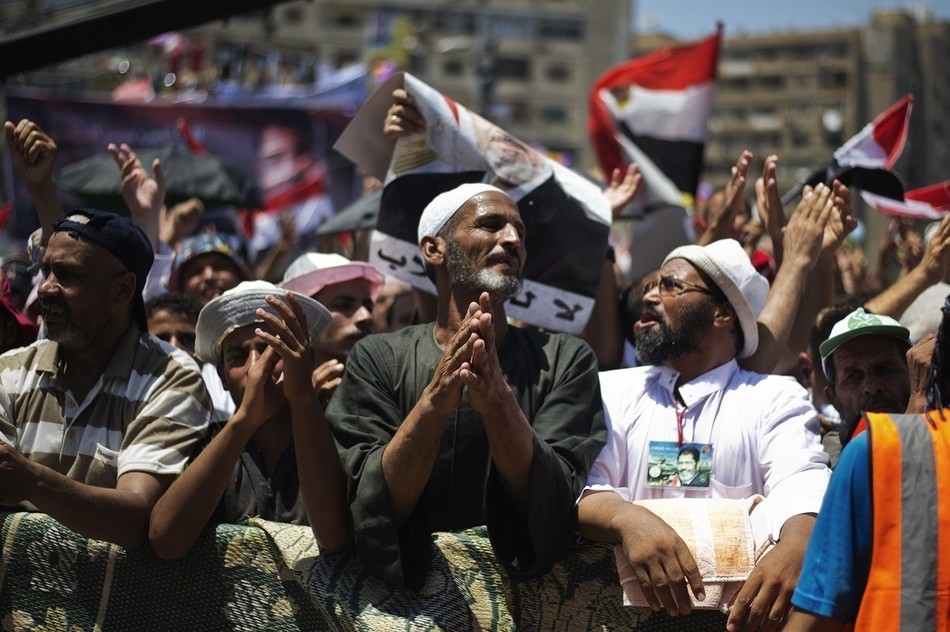
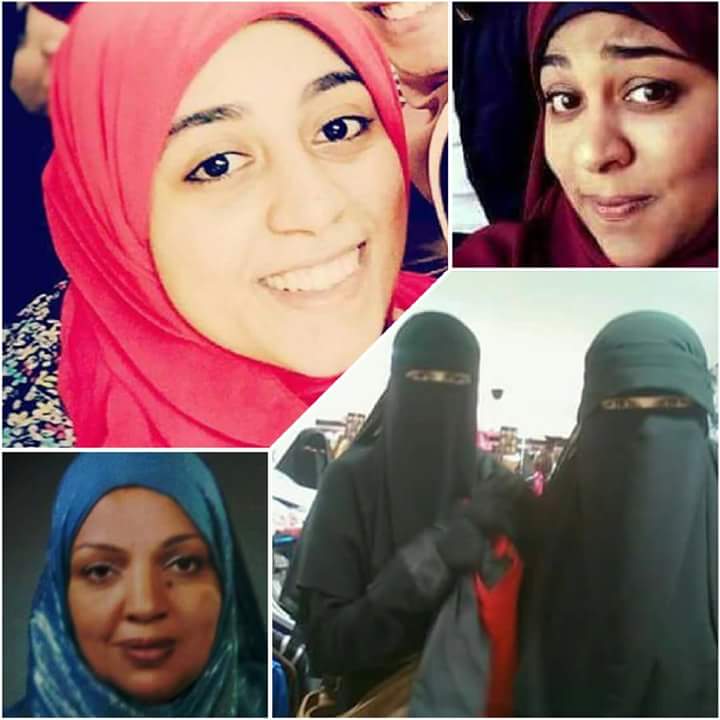
The false secular vs Islamist dichotomy forced upon us by many lead people to label any seemingly practicing Muslim (Bearded men, Niqabi women and the like) as a supporter of Morsi and the Muslim Brotherhood automatically. This oversimplification makes things easier to understand for the Islamophobe westerners and easier to promote for secular Egyptians, but in reality things are not like this.
 

June 30 was also about 9 death cases confirmed, hundreds of injuries, and over than 42 sexual assaults reported in Tahrir only. Uproar in Assiut in upper Egypt where pro- and anti- folks started killing each other and people are still shooting each other outside of the main Muslim Brotherhood HQ in Cairo. 

Yes, all of this ugliness is happening behind the scene while you're enthusiastically sharing the images you find inspiring and awesome on your smart phones and Macs. There are different sides to the story, and different ways to look at it, but keep in mind when you choose to give a blind eye to reality you do this because you're still in a place of privilege.

It's true this is not affecting your life in anything, but remember it does with us.

*********
Sexual harassment in the protests in Egypt. Don't be silent!

1- Mob sexual assault on a female journalist from the Netherlands in Tahrir square On June 28th 2013:

http://www.youtube.com/watch?v=_CMBnImNySA

Another video angle to the same incident:

http://www.youtube.com/watch?v=9R7Yy_UPbNE

2- June the 30th the men talk about an attack on the women warning others from going into the area in Tahrir.
Female protesters are talking about what happened to them.

http://www.youtube.com/watch?v=2E3QZmhbuho

3- Sexual assault at the presidential palace June the 30th

http://www.youtube.com/watch?v=R4ihg7iuK1w


 http://www.jadaliyya.com/pages/index/12565/no-apologies

Wave Of Men Targeting, Sexually Assaulting Women At Egypt’s Anti-Government Protests

http://talkingpointsmemo.com/news/men-targeting-sexually-assaulting-women-egypt-protests.php