Showing posts with label Revolution. Show all posts

8/17/18

Rabaa: The massacre that ended the Arab Spring


This article appeared originally on Middle East Eye:


We are publishing this as a 101 guide for those who don't know all about the massacres and the military coup. Most of the English articles we come across are reductive, biased, or and inaccurate but this article was closer to the truth and to what we have experienced and what our friends and family members have seen. 

*********************
Five years ago, Egypt witnessed the Rabaa massacre, often described as the end of the Arab Spring.
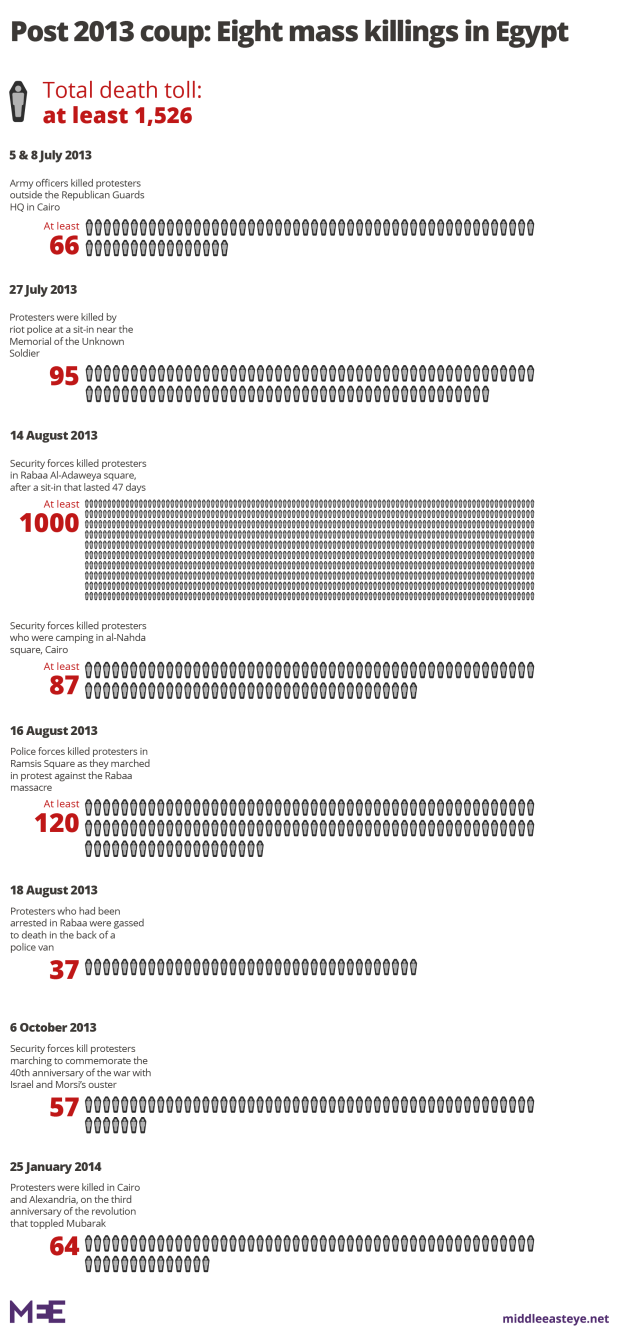
On 14 August, 2013, Egyptian security forces conducted a brutal operation to clear thousands of protesters, killing at least 1,000.
Many call it the worst mass killing of demonstrators in modern history, with its death toll surpassing the Tiananmen Square massacre in China in 1989 and the Andijan massacre in Uzbekistan in 2005.

What led to Rabaa?

On 30 June 2012, in the aftermath of the pro-democracy 2011 Egyptian revolution, Mohamed Morsi, the chairman of the Freedom and Justice Party and high-ranking Muslim Brotherhood member, became the first freely-elected civilian president in Egypt’s modern history.
Morsi’s tenure was short-lived, however. Exactly a year after his election victory, Morsi's opponents staged nationwide protests, blaming him and his party for the deteriorating economic and political situation the country was in.
The protests were backed by the army, and on 3 July, 2013 Morsi was deposed by a military coup by his defence minister, Abdel Fattah el-Sisi, who is now president.
In response, Morsi's supporters and critics of the coup, including Muslim Brotherhood members and pro-democracy civilians, staged nationwide protests demanding he be reinstated and a return to democracy.
The largest sit-in was held in Rabaa al-Adaweya Square in the northern Cairo district of Nasr City. Some 85,000 protesters camped there for six weeks until they were violently dispersed, in what became known as the Rabaa massacre.

Was Rabaa the only massacre?

All major protests demanding Morsi's reinstatement were crushed by brutal force.
In July and August 2013, five separate mass killings took place, as Egyptian security forces killed at least 1,150 protesters in what were widely considered crimes against humanity. Investigations by independent rights groups reported that the killings were intentional and systematic.

 Who were the protesters?

Estimated to be nearly 85,000 people strong, protesters at the Rabaa sit-in were overwhelmingly peaceful, middle-class Egyptians. Many were said to be members of the Muslim Brotherhood, but many others were non-partisan civilians opposed to the coup. They included women, children and elderly people.

What happened in Rabaa?

Egyptian authorities promised a gradual dispersal of the protest, and said they would provide safe exits for people to leave the square.
The actual dispersal, however, was the opposite of that. In the span of 12 hours, from sunrise to sunset, security forces fired live ammunition on large crowds of protesters in intense fusillades.
The security forces used armoured personnel carriers (APCs), bulldozers, ground forces and snipers. They were covered by army tanks deployed outside the square.
Then-Interior Minister Mohamed Ibrahim later admitted in a TV interview that he had anticipated at least 2,000 fatalities among the protesters during the dispersal. This was echoed by then-Prime Minister Hazem Beblawi, who also said in an interview with the press that “the final outcome was less that we expected”.
The square was besieged for most of the day. Attacks were carried out from all the five entrances to the square, making it lethal for trapped protesters to try and leave the square or for the wounded to be transported to hospitals. Many of those who tried to escape were shot dead.
Most of the casualties were shot in the head, neck or chest.
Towards the end of the operation, security forces advanced towards the mosque and hospital in the centre of the square and asked the volunteer medics present to leave the wounded behind and exit the square. Then they set fire to the mosque and hospital, including the corpses of those killed and the wounded protesters who were still alive.
Evidence documented by independent rights groups suggests that most of the security forces' fire targeted crowds of unarmed protesters, which led to the high number of casualties.

Who were the victims?

Around 1,000 protesters are estimated to have been killed on that day. They included at least 30 children and 19 women, most killed by bullets to the head or chest.
Security forces detained 800 protesters over the course of the day, and summarily executed many of them.
Several journalists were killed while covering the event, including British Sky News cameraman Mick Deane, and two Al Jazeera cameramen.
Although the protesters were largely peaceful, the official Forensic Medical Authority said eight police officers were killed on that day.

Who was behind the operation?

The Rabaa operation was carried out by the interior ministry, then led by Ibrahim, and supervised by Sisi, who was defence minister and deputy prime minister for security affairs. The commander of police forces on that day was General Medhat Menshawy.

Was anyone prosecuted?

Yes, the surviving protesters. Not a single official was held accountable for Rabaa massacre. Menshawy, who was in charge of carrying out the operation, was later promoted to assistant minister of interior for central security. All officers who participated in the sit-in were given a bonus in recognition of their efforts. Sisi became president in June 2014.
On 3 July 2018, marking the fifth anniversary of the coup, the Egyptian parliament approved a law that exempts senior army officers from prosecution for any acts committed since July 2013. That includes Rabaa and seven other mass killings.
Nearly 1,000 protesters were prosecuted and many of them received life sentences and death sentences for their role in the demonstrations that followed the 2013 coup.

How did the world react?

The European Union and the United States condemned the killings, but later carried on business as usual with the Sisi government. The EU suspended its export of military equipment to Egypt after the massacre, but allowed individual states to continue to supply Egypt with weapons.
The US withheld part of its military aid in 2013 and 2017 but then released it, triggering accusations that it gave Sisi a "green light for repression”. Similarly, the UK, Egypt’s largest trade partner, revoked some arms export licences after the massacre, but arms sales later resumed.

7/21/18

A response to the celebrated Egyptian elite "activists'

A group of Egyptian activists and ordinary citizens who are never mentioned in English media coverage

For some reason Middle East Eye decided to interview only a handful of famous activists who are not only known to have very liberal positions, but also are very open about having supported and rallied people in Egypt and abroad for #June30. 

While they have all by a way or another paid a price from their personal freedoms due to the crackdown of the Egyptian military dictatorship on all opponents, they all clearly insist on stating that they "don't regret supporting #June30", a movement recognized as undemocratic, irrational, and catastrophic by all those who care or don't care about the prosperity of Egypt.   

It is shocking and disappointing to see how Middle East Eye is shifting more and more towards giving a platform only to liberal and secular celebrity voices in Egypt, a trend that has been apparent in the majority of western media outlets since protests erupted in Egypt in 2011.

If Middle East Eye is seriously concerned with the Egyptian turmoil they need to do a better job than this. You can hire an Arabic-English translator or try to find more people to interview other than the 10 upper-middle-class Egyptians who supported the coup whom everyone in the world interviews since 2011.

We are writing this blog however because we were delighted to see a wonderfully written response from a commentator on the silly article. The comment breaks down the issue of Egyptian liberal elites contributing to the crisis in Egypt. To our surprise, the comment was by Jim Toth, an anthropologist who studies Egypt, the Arab world, and the wider Islamic community. He has taught at the American University of Cairo and at Northeastern University, and since 2011, has worked at New York University in Abu Dhabi. He is the author of Rural Labor Movements in Egypt and Their Impact in the State, 1961-1992. 

Here is a link to the Middle East Eye article:


http://www.middleeasteye.net/in-depth/A-revolution-betrayed-living-in-Egypt-s-worst-era-1003870706
 
Here is Jim Toth's brilliant response:

Abdel Fatah and her friends are hypocrites. Democracy is when all the people voice their choice and opinion. She and her friends may have their own opinion – support Sisi and oppose Morsi – and so let them vote their choice along with all the millions of other voters in Egypt by holding honest elections. 

But to support an anti-democrat such as Sisi and to support the anti-democratic forces that removed Morsi without due process of an election – this is hypocritical. Don’t say Abdel Fatah was a “co-founder” of April 6. She and her friends are still hypocrites because in the last election
prior to July 3, Morsi had won, and they should, if they are true democrats, respect the people’s decision. 


It is not up to them and their elitist friends (the National Salvation Front) to use their social position, their access to the media, and their westernized demeanor to then remove a democratically-elected president, or support his illegal removal, whether or not he made serious mistakes (mistakes that were amplified and exaggerated by an anti-Brotherhood media). 

Nobel prize? Perhaps she ought to stand in line behind Trump. Both are so preposterously unqualified for a Nobel prize that to consider them seriously degrades the value of the prize itself.

For good reason or bad, the majority of ordinary Egyptians had voted in Morsi, and thus, Abdel
Fatah, along with her elitist friends, along with Sisi and the military, have no right in a democracy to overturn the election, unless they are willing to admit it is anti-democratic act and, therefore, the first step on the road to an authoritarian regime. To then pat themselves on the back and say “what good liberals we are” is the height of hypocrisy.


Is this a conflict between “east Cairo” (old Islamic Cairo) (along with Giza) against European Cairo (the nationalists) and the “wings” of New Cairo and October 6 (the neo-liberals)? Abdel Fatah and her crowd are so willing to dismiss the values and principles of the majority of her country-men and -women in those areas who wanted, and voted for, an uncorrupted (naïve?) candidate as president, one that did not have all the un-Egyptian trappings of ibn al-zayyat. In the last presidential elections, many more Egyptians supported a Muslim Brotherhood government than they supported a secular, westernized elitist government. 

She and her friends ought to recognize that, show some humility, some respect, and in democratic fashion, work within the system rather than support and commit extra-legal, unconstitutional acts.

For all her deeds, and those of her friends, they got Sisi, a 100-fold worse than Morsi. Had they been patient, respectful, and lawful, or had insisted on respect, legitimacy, and real democracy, they would not be stuck with Egypt’s worst dictator.

Perhaps they got what they deserved, but, of course, they are not going to be the ones who really hurt for it. But it is the Egyptian people, those unable to make it through the dismal economy and those jailed for belonging to the Brotherhood, who do not deserve this calamity. 

This crime lies squarely on the shoulders of the secular liberals who ought to have known better, but made a pact with the devil in order to assure themselves that their beliefs and way of life are better than those of the majority of Egyptian.

2/28/18

Statement on recent BBC report Feb 2018


The BBC made a story recently on politically motivated enforced disappearances in Egypt after the military coup in 2013. The report featured a few cases one of them was a middle aged Egyptian woman who spoke on her daughter named Zubayda who was kidnapped and disappeared by the Egyptian state for over a year. Her testimony brought so much attention and created an uproar in the Egyptian social media sphere to the degree that the Egyptian state had to do something.
This isn't the first time local and international human rights organizations or international media spoke of the phenomenon. When the Italian PhD student Giulio Regeni was disappeared and then killed in Cairo the whole world spoke of the incident for a long time. Local and international human rights organizations have documented and spoke of 1,000s of enforced disappearance cases for the past 4 years.
However, this latest report seemed to disturb the Egyptian state so much to the degree that they eventually forced the young woman Zubaida who was disappeared for a year to come on Egyptian TV and deny that she was arrested and disappeared as the BBC report showed. It was a pathetic set up and it was clear that Zubayda had to do this under so much pressure. Her mother who appeared on the BBC was detained today, Feb 28th, 2018.
The Egyptian general prosecutor ordered lawyers and prosecutors to "Watch and report news and reports made by forces of evil". Pro-Sisi's social media accounts are roaming the internet denying that there is any torture, imprisonment, or enforced disappearances in Egypt.
While there is some spotlight on the situation in Egypt and while the issue is hot, we wanted to remind the international community and those who are confused because they can't get reliable information on what is going in Egypt that there are atrocities being committed in Egypt while the whole world is ignoring us.


We wanted to remind all of you that there was a military coup in July 2013 and that as a result of this tragedy thousands of Egyptians have paid a very high price for standing against injustice. We wanted to remind all of you that there are tens of thousands of unjustly imprisoned men, women, boys, girls, and elders whose only crime was speaking up. Ignoring what is going on in Egypt while you can say something helps the Egyptian state continue to get away with all of this.
We would like to salute all of the local Egyptian human rights organizations and human rights defenders who are working under so much pressure and risking their lives and future by continuing to do this work with very little support and recognition.
We would also like to thank the BBC team and those in HRW and other international organizations for utilizing their privileges and speaking about what is going on in Egypt from time to time.
Please check out our archives on the blog here as well as the following outlets for more related information and detailed reports on enforced disappearances in Egypt after the military coup:

The Egyptian Coordination for Rights and Freedoms

Verità per Giulio Regeni

12/16/17

Sara and Rana: Islamophobia, profiling, and political imprisonment


Sara ( 26 years old) and Rana ( 24 years old) are two sisters in their early twenties with medical and scientific degrees, one of them is a doctor and the other is a pharmacist, their father is a respected university professor of science.

Two years ago, they were stopped while driving to Alexandria in a security checkpoint only because of the Niqab they wear (Egyptian security forces question all religious Muslim looking individuals for nothing but the way they look like) and then the two sisters where kidnapped and disappeared.

They appeared in detention, they put them in prison and accused them of "Bombing the embassy of Niger!!" a completely random case with no evidence or basis to the accusation.

Their brother was actively campaigning to release them and then eventually was arrested and put in prison too for speaking about the case.

Today after 2 years of detention and out of nowhere one of the sisters (Sara) was given a death sentence and was told that she will be executed soon!

There is a very long history of secular security forces led attitudes of Islamophobia and discrimination against religious looking Muslims in Egypt since the times of Nasser, Sadat, and Mubarak.

This targeting intensified since the military coup in 2013 and was encouraged by the Egyptian and western media alike. So many Egyptians are targeted and thrown into prison only on the basis of their looks.

Women like Sara and Rana don't get any media or human rights support because of how they look like and this is very unfair. Please speak about their case!

11/28/17

Human Rights Day 2017: #SpeakUp4Egypt

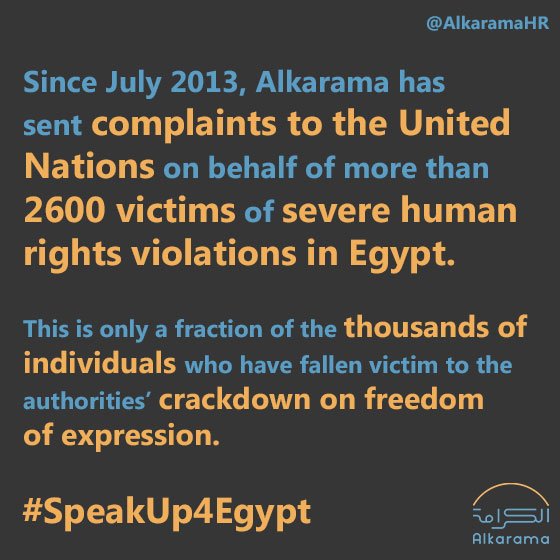
The following media is part of a campaign launched by Al Karamah foundation ahead of the International Day for Human Rights to raise awareness about the overlooked ongoing human rights crisis in Egypt. Please follow and write on the hashtag: #SpeakUp4Egypt on Twitter and Facebook.


Image may contain: 1 person, smiling, text and closeup

This is the campaign's video:


The following video profile is on a young Egyptian photographer who is a victim to the unfair judiciary and military system in Egypt.

On June 1, 2015, Omar Mohamed Ali and his wife, Esraa Eltaweel, were leaving a restaurant in Cairo when they were stopped by police officers, and subsequently disappeared for 15 days. While Esraa was charged with "spreading false news" and imprisoned for 7 months, Omar's case was transferred to a military court, and he was sentenced to life in prison on May 29, 2016. Omar was charged with "leaking classified military information", though no evidence has ever been found against him.


11/21/17

Disability as a price for #Jan25

The following are two examples we came across for ordinary young Egyptians who lost the ability to walk in their early twenties as a result of being injured in a peaceful protest against the military leadership after the military coup in 2013. 

As always, we try our best to highlight the voices and perspectives which don't get the same attention in the English and western media which likes to paint a black and white image for what has gone and is going on in Egypt. These two had very normal lives like any other university student in Egypt or the world until they decided to stand up for the truth. The price they paid for this was rather expensive.  


Asmaa Gamal who is pictured above is a young Egyptian woman from Alexandria who lost her leg for the revolution exactly 4 years ago, in November 2013. When he was shooting her, the police office said: "Now you won't be able to march in any protests any more".

Asmaa was shot by an Egyptian police officer during a protest in her leg and went through an amputation operation to remove her leg right after that. 

Asmaa walks on one leg since 2013 but since then she has also continued to be a huge source of hope, inspiration, and faith for so many in her circle as well as for thousands of social media followers. 


Mohammad Yousry a young Egyptian man from Alexandria was badly injured by the Egyptian security forces during the protests which took place as a response to the military coup shortly after it took place in July 2013.


He was paralyzed as a result and lost the ability to move. Like many revolutionary youth who were injured during the revolution, he is now on a wheel chair.

When you feel that your loss was big, when you feel despair and disappointed, remember the heroes who fought for a better future for Egypt!

Remember their sacrifices and the very high price they paid for the revolution and for standing up for justice, freedom, and truth. 

4/18/17

Reem Qutb: From Hollywood to women prison in Egypt

A story of a young Egyptian woman from Hollywood to Qanater Women prison in Egypt.
English, Español, Arabic available!

Image may contain: 1 person, smiling, text and closeup
من هوليود إلى القناطر ..
للناس اللي ماتعرفش قصة ريم قطب
ريم مواطنة مصرية بتدرس إخراج في هوليود بأمريكا، كانت جاية مصر يوم 26 ديسمبر 2016 تزور أهلها، فوجئت بأمن المطار بيوقفها عشان معاها كاميرا تصوير متطورة من اللي بتستخدمهم في شغلها ..
ماكتفوش بالتحقيق معاها أو مصادرة الكاميرا، لا اعتقلوها من المطار، بتهمة انها شغالة في الجزيرة "وتم إعدادها وتأهيلها من خلال دورات تدريبية على استخدام طائرات التجسس والتصوير، لاستخدامها فى تصوير الأحداث وإرسالها للقناة فى الدوحة" على حسب وصف الداخلية.
طائرة التجسس اللي بيقولوا عليها دي مجرد كاميرا متطورة بتتباع في كل المواقع، والمضحك انهم متهمين ريم انها هتستخدمها في "إعداد تقارير مصورة تسيء لمصر قبل 25 يناير" وكأنه تصوير مظاهرة محتاج لكاميرات متطورة أصلا، أو إنه الجواسيس بينزلوا بمعداتهم عن طريق المطار بمنتهى الذوق عادي جدا!
ريم دلوقتي اترحلت سجن القناطر بعد شهور في قسم القطامية، وبتتحاكم على 3 تهم (التمويل من جهة أجنبية، انتماء، إشاعة أخبار كاذبة) ..
واحدة من آلاف قصص الظلم والغباء اللي بيحصل في مصر وكتير مايعرفهوش ..

Reem Qutb is a young Egyptian woman who's studying film in California, US. She traveled to Egypt on vacation in December 2016.
Upon arriving to Cairo's international airport, she was arrested for possession of a camera! The security forces accused her of receiving 'foreign funds' and using highly advanced equipments to ruin Egypt's reputation in the international community, an accusation they have ready for any Egyptian journalist.
Reem is now in the infamous Al Qanater women prison. Her list of accusations is: Belonging to a terrorist organization, receiving foreign funds, and spreading false news about Egypt.
Reem wasn't a journalist to begin, she only traveled to Egypt as an Egyptian with a camera. Of course there isn't a single one mention to her case in any non-Arabic media outlets. 
Español

Reem Qutb es una joven egipcia que estudia cine en California, Estados Unidos. Ella viajó a #Egipto de vacaciones en Diciembre del 2016.
Al llegar al aeropuerto internacional de #El_Cairo, fue detenida ¡por posesión de una cámara! Las fuerzas de seguridad la acusaron de recibir fondos extranjeros y del uso de equipo avanzado para arruinar la reputación de Egipto ante la comunidad internacional; acusación que tienen preparada para cualquier periodista egipcio.
Reem ahora está ahora en la infame prisión de mujeres de #Al_Qanater. Su lista de acusaciones es:
- Pertenecer a una organización terrorista
- Recibir fondos del exterior
- Difusión de noticias falsas sobre Egipto.
Para empezar, Reem, sólo viajó a Egipto con una cámara. No hay ni una sola mención de su caso en ningún medio de difusión no árabes.

Image may contain: 1 person, smiling, sitting, text and indoor

3/14/17

Pictures: 200 political prisoners released in Egypt

The Egyptian military government decided to pardon 200 Egyptian prisoner. Take a look at this emotional and powerful moment, at this expression of freedom.
These prisoners suffered so much inside and their families suffered with them along the way. 

It's worth mentioning that the Egyptian state media declared that they will not pardon a single one member of the Muslim Brotherhood or any political Islamic movement in Egypt. This verify two things:

1- The secular Egyptian state is oppressing and discriminating against Egyptians who have certain political and intellectual orientation even while they are innocent and non-violent.

2- There are over 60,000 Egyptian political prisoner and they are not all only Morsi supporters and Muslim Brotherhood like the western media likes to label them all.

Check our Facebook page for more pictures and news:


11/24/16

Pictures: Egyptian political prisoners and their families!


Families of political prisoners in Egypt communicate with their loved ones through sign language because they can't get any closer. Look at the pictures and try to put yourself in their place. 


"Your mother is sending her greetings to you".

10/19/16

Human Rights in Egypt after the military coup: A detailed report


Do you hear about Egypt in the news anymore? If you are someone who followed Egypt after the military coup in 2013 you probably came across very few articles here and there. 

News updates on explosions, bombing, and infrastructure accidents usually get the most attention, if any. However, barely anything is said in English on the unprecedented scale of human rights violations, political persecution, and the social frustration and pressure affecting the lives of millions of Egyptians.

For decades and especially after the revolution in 2011, the Egyptian people who are experiencing human rights violations who are not English speakers, who reside outside of the center of attention don't get the same recognition internationals and celebrities receive when they are under the grip of the Egyptian state.

Unfortunately, this is something international news agencies and many of the advocacy groups fail to understand and as a result it has been one of our main motivations to do our translation work.

Earlier this year and for several months, members of our initiative coordinated with an aspiring human rights organization which shares the same concerns. For two years now The Egyptian Coordination for Rights and Freedoms has been trying to offer a neutral grassroots documentation of the human rights crisis in Egypt regardless of the ideology, political affiliation, or social class of the victim or their families. 
Their incredible work received the attention and was cited in several human rights reports and news articles but they still struggle so much to reach a wider audience due to their limited resources and linguistic abilities. 

The following post is a translation by one of our members for a summary and an introduction to one of their major projects so far. 
The project was a detailed report on human rights violations since July 2013 and up until the end of 2015. We worked for a few months on re-writing and editing the English translation of the Arabic report. It was a very challenging piece of work. Unfortunately, the original translation was done by a group of Egyptian recent graduates who were arrested afterwards. 

This is highly important work that didn't get the attention it deserved then, it's almost 2016 now but much of what's in the report hasn't changed yet. 

After reading this summary, you can easily download the English PDF version of the report here:
http://ecrfeg.org/en/2016/05/21/human-rights-in-egypt-where-to/


The Egyptian Coordination for Rights and Freedoms
The Summary of 2015 
Human Rights in Egypt: What could possibly be worse?
Since the establishment of the Egyptian Coordination for Rights and Freedoms, it has issued more than 40 reports over the course of the past 18 months. In addition to the annual and semi-annual periodical reports, a special annual report was issued for the year 2015, monitoring and documenting the violations of the Egyptian authorities against its citizens over 2015. This report notably is the most comprehensive report on the state of human rights in Egypt since the events of July 3, 2013.

The methodology of the reports is based on information gathered on a daily basis within "The Monitoring and Documentation Units" in the organization. These units are connected to another team within the Coordination, the team of human rights activists and lawyers who are based all over Egypt and are working to monitor all violations against the rights of the Egyptian people, following websites and official publications. In addition, these different units are communicating directly with the victims of the violations and their families.

The annual report is divided into three main sections each of which includes several chapters and subsections:

-The first section deals with: "Violations of civil and political rights", and discusses the following violations: Murder, arbitrary arrests, forced disappearances, torture in prisons and detention places, death penalties on political basis, the siege of villages and towns, violations against the most vulnerable groups (Children and women) and people with special needs, violations against immigrants and refugees, military trials for civilians, violations against students and university professors, violations against lawyers and professionals, and violations against human rights activists and journalists.
- The second Section deals with: "Violations of economic and social rights", and discusses dismissals from work places as well as another phenomena in the Egyptian society which is suicide.
- The third section includes an explanation of the general environment or legal framework for human rights research.

Egypt: Human Rights Violations in Numbers

Arbitrary Killing: In 2015, the Egyptian Coordination monitored 335 cases of extrajudicial killings where: 7 citizens were killed by execution; 27 citizens were murdered through torture; 87 citizens were murdered by medical negligence; 50 citizens were murdered during protests; and 143 citizens were killed by live ammunition or by throwing them from the rooftops or by killing them in an unknown explosive accidents; apart from 21 dead due to sectarian violence.
Torture: In 2015, 387 cases of torture were documented based on complaints received directly from victims’ families; a total of 876 cases of torture were documented, including cases without verification from victims’ families.
Death Sentences on a Political Basis: We monitored 1763 cases that were referred to the Grand Mufti, including 1758 males and 5 females, of whom 4 defendants died in detention after referral to the Mufti. During the time period of the report, 729 death sentences were issued; of whom 427 were sentenced to death and their appeal has not yet been considered; 260 were sentenced to death and granted an appeal, granting a retrial; 7 were sentenced to death, their appeal was granted with a retrial, and then they were sentenced to death for the second time; 56 were sentenced to death, and they face retrial on lesser penalties or have been acquitted.
Arbitrary Detention: We observed during 2015 approximately 23,000 cases of arbitrary detention of Egyptian citizens. Most of these citizens are under temporary detention, or have been referred to trial - military or civilian trials - in which they are not guaranteed a fair trial.
Enforced Disappearances: We observed 1840 cases of enforced disappearance of Egyptian citizens during the period of observation; approximately 366 of these cases are still regarded as enforced disappearances at the time of this report’s publication, and we will attach to the report a detailed list about people who are still considered cases of enforced disappearance based upon testimony gathered from the families of the victims.
Referral of Civilians to Military Trials: We observed about 6,048 referral of civilians to military courts including 578 students and minors, 74 doctors, 181 teachers, and 30 lawyers. Around 163 of these cases received a ruling, wherein 18 civilian citizens were sentenced to death, more than 1000 were sentenced to life imprisonment, and thousands more were sentenced to serve prison terms ranging from 7 to 15 years. 

Violations against the Most Vulnerable Groups


Women: Our report confirms the continuation of state-supported oppression of the Egyptian women since July 2013 and until today. Oppression of women included all kinds of abuse, ranging from murder, enforced disappearances, arbitrary detention, violations against minors, mothers, and wives, and arbitrary sentences. There have been more than 2,000 women and girls detained in the period from July 3, 2013 until the end of 2015.
As of this report’s publication, there are still sixty (60) women subjected to arbitrary detention by the security forces, some of whom have faced fabricated accusations on political basis.
Children: Egyptian minors are exposed to sever amounts of violations, over 2015 there were 630 arrests, 16 cases of extrajudicial killings, 250 cases of torture, 121 cases of enforced disappearances, and 89 cases medical negligence inside prisons.
People with special needs: The Coordination monitored 480 cases of detention, arrest and court rulings against people with special needs or disabilities.
Refugees: According to official sources, there are 80,000 Syrian refugees in Egypt, other sources indicate that the number of Syrian refugees in Egypt has increased to 250 thousand. Refugees were exposed to serious violations including arbitrary arrest and forced disappearances, in addition to restrictions on the issuance of residence permits which forced many of them to escape Egypt through different ways. We managed to monitor the presence of 44 Palestinians in Egyptian prisons and four cases of enforced disappearance.

Freedom of Movement, Thought, and Expression
Media and journalism: We documented the following violations against journalists and media workers:
1.   The killing of 4 journalists in different violent incidents.
2.   The enforced disappearance and torture of 14 journalists.
3.   193 instances of physical abuse during media and press coverage.
4.   50 cases of arbitrary detention of journalists.
5.   38 journalists and media workers were referred to criminal trials, whether civilian or military trials.
6.   12 TV programs were prevented from airing.
7.   Egyptian security and/or police raided the headquarters of 14 newspapers, satellite television channels, and news websites.

Freedom of Movement: During this period the siege of several villages and cities was observed in various governorates of Egypt, preventing citizens from moving freely, restricting them, and arbitrarily detaining a large number of citizens. In addition to this, a large number of citizens were prevented from traveling, particularly jurists, journalists, and community figures. The number of Egyptian prisons increased from 42 to 51 after nine new prisoners were built in 2015.
Economic and Social Rights
The rise of suicide rates and incidents in Egypt raised red flags and media attention last year. The Coordination monitored 215 suicide cases in 2015 alone, 174 of which of were males and 41 females. 52% of the suicide cases are for people between the ages of 18-35.
In the same context, the report monitored that the administrative body of the Egyptian state has listed more than 5,000 government employees working in various ministries and ordered their dismissal based on charges of “belonging to political and/or religious organizations” without evidence of any crimes. Among these names were 51 judges, 671 media worker and journalists, 46 university professors, and 200 teachers who were all dismissed from work on political basis in 2015 alone.
Recommendations
At the end of the report, The Egyptian coordination recommended that a neutral investigation committee needs to be established in order to examine all the reports and complaints regarding the violations of the political, human, and social rights of the Egyptian citizens.

The Coordination demanded the assertion of the right to freedom of expression, the immediate cancellation of military trials for civilians and the release of all civilians convicted in military trials, the immediate cancellation of “Protest law” and other similar restrictive laws and releasing all political prisoners who’re arrested under their pretext, and finally reviewing all political death sentences in the past 3 years and asserting the right of those sentenced to death to fair civilian trials.
The Coordination also demanded that the United Nations and the international community have a serious participation in pressuring the Egyptian state to abide by and respect international human rights covenants, measurements, and laws.
Finally, the Egyptian Coordination for Rights and Freedoms asked that the UN and the international community should have an open position and not be silent on the violations of human rights taking place in Egypt. The Coordination emphasized the dire need to support and amplify the efforts of local civil society and human rights organizations operating under critical conditions so that they can continue to do this work and be committed to serving the Egyptian people and the victims of human rights violations.